


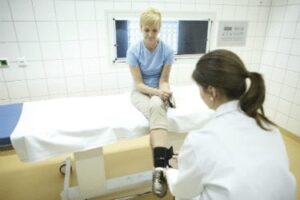
 An ankle brace can be an important aid to recovery, whether it’s after an injury picked up in sport or one of the many accidents that can happen in everyday life. Styles vary according to need, but the device should be stiff or stretchy with the option of plastic or metal supports for more control or to prevent potential problems. The stronger types tend to be fastened with laces or velcro, whereas lighter pull-ons are used to reduce inflammation. Whatever the issue, it’s always sensible to seek medical advice to determine the most suitable treatment – correct care after a fall could be crucial.
Sprained Ankle
 A sprained ankle is a common complaint and if you’ve ever suffered from one, you will know just how painful it can be in its worst form. That’s hardly surprising because it’s basically a torn or stretched ligament, the latter being what connects bones at the joints and keeps them in place. Initial swelling can be dealt with by applying ice packs. The affected part can then be protected by fitting a reinforced brace or a splint for anything up to six weeks, until all swollen areas and discomfort have disappeared.
If you’re prone to sprains or you are active in sports where it’s a likely hazard, you could consider protecting yourself just in case. An ankle guard provides an economical alternative to taping, with the added advantages that it can be applied and removed by the wearer, re-used and easily adjusted for comfort. Keep it just tight enough for support but be careful not to impede circulation.
Preventative Action
An uninjured athlete may prefer to use an ankle brace or wrapping for a one-off event, or on a regular basis to support a weakness or to protect vulnerable ligaments and bones in a fall. In disciplines such as football and basketball, players often retain them for practice sessions which could prove just as risky. Runners adopt the same approach, although they take care not to become too dependent in case their muscles adapt wrongly, leading to weaker ankles. High-top shoes will help in a similar way.
British tennis player Andy Murray is a keen advocate of preventative action, having suffered from ankle problems throughout his career. He favours lightweight and breathable models that allow him to change direction quickly and with confidence.
Strengthening Exercises
 It’s wise to exercise to strengthen any weakness and not to depend entirely on artificial reinforcements, which might limit mobility slightly in some cases and perhaps delay a return to full use of the limb. The primary purpose of an ankle brace is to immobilise the injured ligaments to allow them to heal unhindered. Once you feel that you have passed this stage, consult a health or sports professional and if they give you the okay, you can discard the bracing but continue with exercises to toughen the area. Stand on the leg for a very short period, gradually increasing the time as and when your foot can cope with it.
It’s not just in everyday situations and exercising that guards are needed, either. Protective clothing might provide some safety in more extreme sports too, with a trauma surgeon suggesting that skydivers should don ankle braces and spinal supports to cushion the impact of fast and uncontrollable landings!
If you have ankle pain get in touch with us today to book an appointment.

